
PokeBonk Survival Mode: Goals & Run Progress
Current source scope: Beta v0.7.3 · Checked October 19, 2026
THE QUICK ANSWER
Select Survival from the run setup when it is available. Its objective is to last as long as possible, with increasing pressure and milestones at 15, 30 and 45 minutes. It records endurance rather than a Classic three-zone completion; a planned Season 2 rework is not a released rule.
In these notes
Enter the mode and understand the scorePlan around the announced milestonesClassic portals and migration portals are differentKeep run progress and future plans separateSources and version scope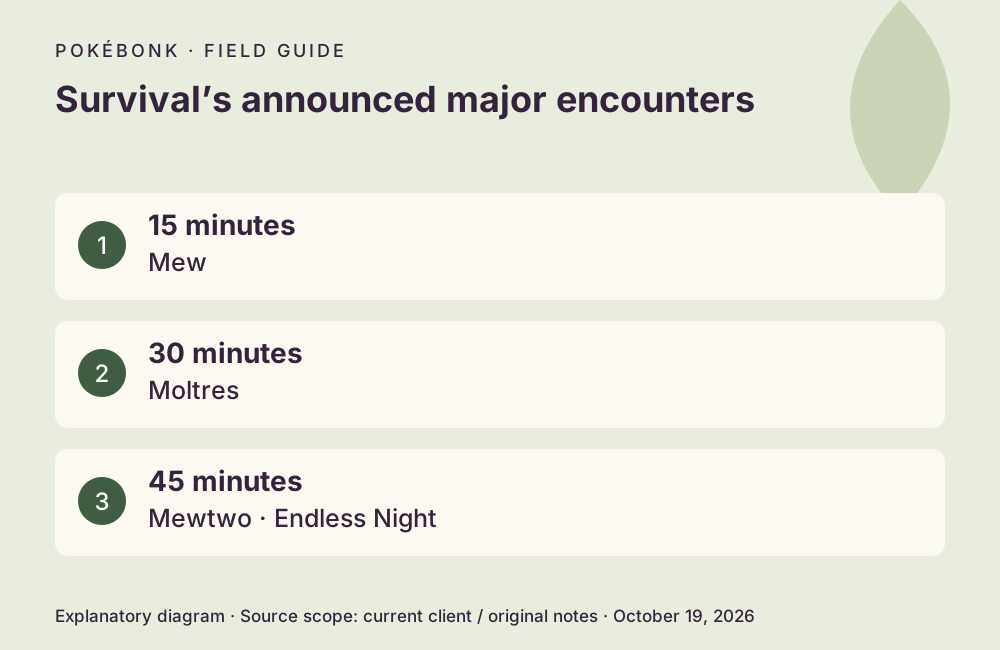
Enter the mode and understand the score
Choose Survival in the mode selector, then the available region and partner. If a lock appears, read its current prerequisite; this guide does not invent a universal unlock condition for every profile. The goal is elapsed survival time. The Survival leaderboard uses best time for each region, with KOs as a tie-breaker. Account eligibility still applies.
Unlike Classic’s zone-and-guardian route, Survival continues under escalating enemy pressure. A faint or end-of-run result ends the attempt; wait for its save confirmation or recovery prompt. Run recovery is a fallback path, not a guaranteed way to erase every failure.
Plan around the announced milestones
Hostile-ground warnings are announced with a two-second lead and can affect enemies too. Pacts trade a power for a curse; no source here establishes a universally safe pact order. The current achievements explicitly include surviving ten and thirty minutes and defeating Mewtwo at minute 45.
| Time / event | Documented change | Decision it creates |
|---|---|---|
| Every five minutes | Milestone pressure / pact choices in the mode’s notes | Read the power and curse together before accepting. |
| 15 minutes | Mew encounter | Keep movement space and account for the new threat. |
| 30 minutes | Moltres encounter | Do not treat ordinary-enemy clear speed as boss safety. |
| 45 minutes | Mewtwo and Endless Night progression | A late-run endurance challenge, not the end of all pressure. |
| Roughly every two minutes | Comet charging-circle event in the mode announcement | The circle offers a blessing and PokéDollars, but holding position is a tradeoff. |
Classic portals and migration portals are different
Older mode text calls Survival a single-map mode without Classic zone portals. Patch #5 separately introduced a migration portal every eleven minutes, open for ninety seconds. Read that as a timed migration feature rather than copying the old “no portals” line as a ban on every portal. The navigation guide keeps this distinction explicit.
The announced respawning interactables and support encounters give more reasons to revisit areas. They do not mean the guardian altar → exit loop from Classic becomes Survival’s objective. Shiny legendary rules also differ: the current client excludes Survival from its ordinary shiny-legendary roll.
Keep run progress and future plans separate
After a run, check the actual saved result, achievement counters and account leaderboard entry. Guest runs do not gain leaderboard eligibility simply by lasting longer. Clan Survival contribution was included in Patch #7 fixes. See what a clan actually does.
The October 19 roadmap announces a Survival rework for Season 2. It does not define already-live replacement milestones or a released co-op Survival mode. The roadmap section distinguishes those plans from the current rules. No run was played to validate a winning Survival build.
Sources and version scope
This independent guide uses the original project’s menu text, current client definitions and dated announcements. Menus were inspected; no run, purchase, reward claim or account recovery was played through for this guide.
- Original English entry — v0.7.3, entry and menu observations checked October 19, 2026.
- Original news feed — Patch #7 and earlier mechanic changes; roadmap statements retain their announced scope.
- Current roster and upgrade definitions and client rules — exact definitions, not a claim about every server outcome.
Source-check dates are separate from publication dates. This page is part of a local preview. Read the source and artwork approach.